

Quick Comparison: Private Label Skincare vs. Contract Manufacturing
The main difference is usually how the product is developed and specified. Private label skincare commonly starts with an existing manufacturer-developed formula, while contract manufacturing describes a broader production arrangement that can involve a brand's own formula, a custom-developed formulation, or an agreed product specification.
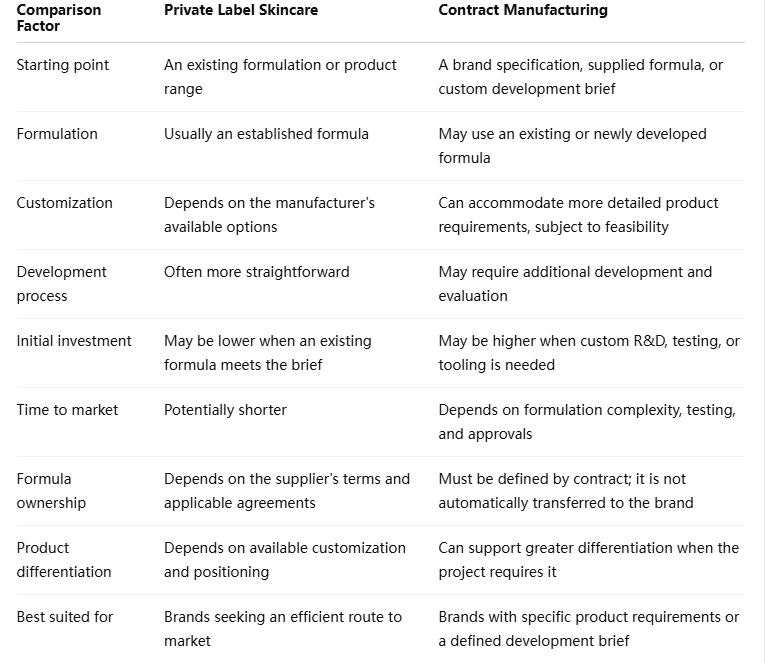
Important: These are general tendencies, not universal rules. Some private label manufacturers offer extensive customization, while some contract manufacturers specialize in producing existing formulas. Always confirm the actual scope of services, costs, timelines, and intellectual property terms with your manufacturing partner.
1. What Is Private Label Skincare Manufacturing?
Private label skincare manufacturing allows a brand to select an existing product or formulation from a manufacturer's available range and sell it under its own brand name.
Instead of developing every aspect of a product from the beginning, the brand works with the manufacturer to select a suitable product and determine which customization options are available.
Depending on the manufacturer, these options may include packaging selection, label design, product size, fragrance, texture, or certain formulation adjustments.
For example, a new beauty brand might want to launch a hydrating facial moisturizer. Rather than commissioning a completely new formulation, the brand could select an existing moisturizer that meets its product brief and customize the packaging and branding.
The manufacturer produces the product, while the brand focuses on its market positioning, sales channels, marketing, and customer relationships.
Benefits of Private Label Skincare
A more accessible starting point
Private label can help brands enter the skincare market without taking on the full scope of custom formulation development. This can be particularly useful for startups testing a product concept or businesses expanding into a new category.
Potentially faster product development
When an existing formulation is suitable and the required evaluations have been completed, the development process may involve fewer steps than a completely new formulation project.
The actual timeline still depends on sample approval, packaging availability, labeling, testing requirements, and production scheduling.
A more predictable development process
An established product and manufacturing process can make it easier to define the initial project scope. Brands can concentrate on choosing suitable products and creating a consistent brand identity.
A practical way to test market demand
Private label may allow a brand to evaluate customer response before investing in more extensive product development. Whether this is financially practical depends on the manufacturer's MOQ, packaging requirements, and the brand's budget.
Potential Limitations of Private Label
Private label is not automatically the best choice for every skincare brand.
The available formulation range may limit your ability to achieve a specific texture, ingredient profile, product performance target, or other distinguishing characteristic.
In addition, an existing base formulation may be available to other customers. If your brand strategy depends on a highly distinctive product, you should ask about customization limits and exclusivity arrangements before proceeding.
Formula ownership also requires attention. Using a manufacturer's existing formulation does not automatically give your business the right to transfer that formula to another factory.
Private label is often a good fit when speed, simplicity, and an efficient product launch are more important than developing a highly customized formulation.
2. What Is Contract Manufacturing in Skincare?
Contract manufacturing is an arrangement in which a brand hires a third-party manufacturer to produce skincare products according to agreed specifications.
The brand may provide an existing formulation, work with the manufacturer's R&D team to develop a new product, or agree on a formulation and production process with the manufacturer.
Contract manufacturing is therefore a broad term. It does not necessarily mean that every product must be developed from scratch.
For example, an established skincare brand may want to create a lightweight facial serum with a particular texture, ingredient profile, packaging format, and target price.
The brand can provide a detailed product brief and work with the manufacturer to assess feasibility, develop or adapt the formulation, evaluate samples, and prepare for production.
The exact process depends on the project's complexity and the services agreed upon.
Benefits of Contract Manufacturing
Greater flexibility in product development
Contract manufacturing can accommodate specific product requirements that may not be available through a standard private label range.
These requirements may involve texture, sensory characteristics, ingredient selection, packaging compatibility, or other formulation targets.
More opportunities for product differentiation
Brands seeking a distinctive product concept may benefit from a development process tailored to their target customers and market positioning.
However, a custom formulation does not automatically guarantee uniqueness. Differentiation depends on the agreed specifications, intellectual property arrangements, and any applicable exclusivity terms.
A defined production specification
Contract manufacturing can establish a documented product specification covering formulation, manufacturing parameters, quality requirements, packaging, and other agreed details.
This can support consistency across production batches when the appropriate controls and procedures are in place.
Potential for long-term product development
A manufacturing relationship can evolve as a brand expands its product portfolio, adjusts formulations, or develops new product categories.
The manufacturer and brand should agree on how formulation changes, approvals, documentation, and future production runs will be managed.
Potential Limitations of Contract Manufacturing
A custom project may require more time, communication, and investment than selecting an existing product.
Depending on the project, additional work may include:
- Product brief development and feasibility assessment.
- Ingredient selection and formulation development.
- Sample preparation and revision.
- Stability and packaging compatibility evaluations.
- Safety substantiation and other appropriate testing.
- Label review and market-specific regulatory assessment.
- Production planning and quality requirements.
Not every project requires the same steps or testing program. The appropriate requirements depend on the product, its intended use, the applicable regulations, and the manufacturing arrangement.
Contract manufacturing also requires clear agreements about formula ownership, confidentiality, permitted use, exclusivity, and access to relevant documentation.
Contract manufacturing is often a better fit when your brand has a specific product concept, defined technical requirements, or a long-term differentiation strategy.
3. Private Label vs. Contract Manufacturing: Which Is More Cost-Effective?
There is no universal answer. The more cost-effective option depends on the product, required customization, order quantity, packaging, and total development scope.
Private label may reduce initial development costs when an existing formulation meets your requirements. Contract manufacturing may require additional investment when a project involves custom R&D, specialized packaging, or more extensive evaluation.
However, comparing only the unit price can be misleading.
Before choosing a manufacturing model, consider the following cost factors.
Formulation and Development Costs
An existing formulation may reduce the amount of new development work required.
A custom project may involve formulation development, multiple sample rounds, additional evaluations, and technical adjustments.
Ask your manufacturer which development services are included in the quotation and which may incur additional charges.
Minimum Order Quantity (MOQ)
MOQ depends on more than the manufacturing model.
Factors can include the product type, batch size, packaging components, filling equipment, customization requirements, and production efficiency.
A private label product does not automatically have a lower MOQ, and a custom formulation does not always require a larger order. Request product-specific MOQ information before making your decision.
Packaging and Labeling
Packaging can significantly influence the total project cost.
Standard packaging may offer a simpler starting point, while custom bottles, pumps, caps, molds, or printed components may require additional investment.
You should also consider label design, artwork preparation, packaging compatibility, and the requirements of your target market.
Testing and Quality Requirements
The appropriate evaluations depend on the product and the intended market.
Depending on the formulation and packaging, these may include stability evaluation, packaging compatibility assessment, microbiological testing, or other relevant product safety and quality assessments.
Clarify which activities are required, who will arrange them, and whether they are included in the quoted price.
Production and Supply Chain Costs
Your total cost should also account for filling, packaging, quality control, transportation, import-related expenses, and inventory planning.
For brands sourcing products internationally, shipping arrangements and lead times can affect cash flow and launch planning.
The best approach is to request comparable quotations based on the same product specification, packaging requirements, quantity, and delivery terms.
4. How to Choose the Right Skincare Manufacturing Model for Your Brand
The best manufacturing model depends on where your business is today and what you want your product line to become.
Use the following questions to narrow down your options.
Choose Private Label If You Want to:
- Launch a skincare product using an existing formulation.
- Build your initial product range without commissioning extensive custom R&D.
- Focus more of your resources on branding, marketing, and customer acquisition.
- Evaluate market demand before investing in a more specialized formulation.
- Select from established product formats and available customization options.
Typical product categories may include facial cleansers, moisturizers, body lotions, body washes, and other skincare products, depending on the manufacturer's capabilities.
Consider Contract Manufacturing If You Want to:
- Develop a product around a specific formulation brief.
- Work toward a particular texture, ingredient profile, or product specification.
- Produce an existing formulation that your business is authorized to use.
- Establish documented product specifications and manufacturing requirements.
- Explore a custom development project for long-term brand differentiation.
The feasibility, cost, timeline, and ownership arrangements should be evaluated for each project.
What If You Need Both?
Many beauty brands use a combination of private label and contract manufacturing.
For example, a startup might begin with an existing moisturizer and cleanser to establish its initial product range. After learning more about customer preferences, the brand may invest in a custom serum or another signature product.
This approach can help a business balance initial launch priorities with longer-term product development.
The key is to select the manufacturing model for each product based on its commercial purpose rather than assuming that the entire brand must follow one model.
5. What Should You Ask a Skincare Manufacturer Before Starting?
Whether you choose private label or contract manufacturing, evaluating the manufacturer is just as important as selecting the production model.
Before committing to a project, ask the following questions.
1. What Formulations and Customization Options Are Available?
Ask whether the manufacturer offers existing formulations, custom formulation development, or both.
Clarify which ingredients, textures, fragrances, product characteristics, and packaging options can be adjusted.
2. What Is the MOQ for My Specific Product?
Request the MOQ for your selected product and packaging combination.
If you are developing several products, ask whether the minimum quantity applies per SKU, per formulation, or per production batch.
3. How Is Formula Ownership Defined?
Determine whether the formulation is manufacturer-developed, supplied by your business, or developed under a separate agreement.
For custom projects, confirm who owns the formula, whether your business receives any transfer or usage rights, and whether exclusivity is available.
Do not assume that paying for formulation development automatically transfers all intellectual property rights.
4. What Testing and Quality Documentation Can You Provide?
Ask about the manufacturer's quality management procedures, relevant testing, batch documentation, traceability, and product-specific records.
The exact documentation should match the product and intended market.
5. What Are the Expected Development and Production Timelines?
Ask for estimated timelines covering sample development, revisions, testing, packaging procurement, production, and delivery.
A realistic project schedule should account for the work required to meet the agreed specifications.
6. What Support Is Available for the U.S. Market?
If you plan to sell in the United States, ask how the manufacturer supports product documentation, ingredient review, labeling coordination, and applicable regulatory requirements.
Responsibilities should be clearly allocated between the brand, manufacturer, and any regulatory specialists involved.
Under U.S. law, cosmetic companies have responsibilities relating to product safety and compliance. MoCRA also establishes requirements concerning facility registration, product listing, safety substantiation, and other matters, subject to applicable provisions and exemptions.
Facility registration or product listing should not be represented as FDA approval of a cosmetic product.
For official information, consult the FDA's Cosmetics Laws & Regulations resources.
6. Why Work with a Skincare OEM/ODM Manufacturer Like Longway?
For beauty brands seeking a manufacturing partner, the goal is not simply to find a factory that can fill and package products. It is to find a partner whose capabilities, communication, quality procedures, and development process fit the project.
Longway works with beauty brands on OEM/ODM product development and manufacturing across selected skincare, sun care, hair care, and aerosol cosmetic categories.
Depending on the product and project requirements, the collaboration may involve:
Product Concept and Requirements
Define the product category, target customer, intended market, packaging preferences, and commercial objectives.
Formulation and Product Development
Discuss available formulations or custom development requirements, subject to technical feasibility and the agreed scope.
Sample Evaluation
Review samples against the agreed product brief and identify any necessary adjustments before proceeding.
Packaging Coordination
Evaluate suitable packaging options based on the product, design objectives, compatibility considerations, and production requirements.
Production Preparation
Confirm the approved specifications, order quantity, quality requirements, packaging details, and production schedule.
Quality and Documentation
Clarify the applicable quality controls, testing, documentation, and market-specific responsibilities for the project.
With experience in cosmetics manufacturing and product development, Longway aims to help brands evaluate practical routes from product concept to commercial production.
The most suitable approach depends on your product, budget, target market, and desired level of customization.
7. Frequently Asked Questions
Is private label skincare the same as contract manufacturing?
Not exactly. Private label usually refers to selling an existing manufacturer-developed product under your own brand. Contract manufacturing describes an arrangement in which a third-party manufacturer produces products according to agreed specifications. These arrangements can overlap, and some contract manufacturers also offer private label products.
Is private label skincare cheaper than custom manufacturing?
It can be less expensive to get started when an existing formulation meets your needs. However, the total cost depends on MOQ, packaging, testing, customization, and other project requirements. Compare quotations based on the same specifications rather than assuming one model is always cheaper.
Can I customize a private label skincare formula?
Sometimes. The options depend on the manufacturer's formulation platform and customization policies. Some manufacturers allow adjustments to fragrance, texture, or other characteristics, while others offer products with limited formulation changes. Confirm feasibility before proceeding.
Who owns the formula in contract manufacturing?
Formula ownership depends on how the formulation was developed, the applicable agreements, and the intellectual property rights involved. A brand-supplied formula may be subject to the brand's existing rights, while a manufacturer-developed custom formula may remain with the manufacturer unless the contract provides otherwise. Define ownership, permitted use, confidentiality, and exclusivity in writing.
Is contract manufacturing better for a new skincare brand?
Not necessarily. A startup with a straightforward product concept may find private label more practical. A startup with a clearly defined product specification or a strong need for differentiation may benefit from custom development. Budget, timeline, MOQ, and available technical resources should guide the decision.
Can I start with private label and switch to custom formulations later?
Yes. A brand can begin with existing formulations and introduce custom products as its business grows. However, an existing manufacturer's formula may not be transferable to another factory. Plan future development with formula rights, product specifications, and supply continuity in mind.
What should I include in an OEM/ODM inquiry?
Provide your target product category, intended market, preferred formulation or product concept, packaging requirements, estimated order quantity, and target launch timeline. If you already have a formula or product specification, mention that as well. These details help the manufacturer assess the project more efficiently.
Conclusion: Choose the Manufacturing Model That Fits Your Product Strategy
Private label skincare and contract manufacturing can both help beauty brands bring products to market without building their own manufacturing facilities.
Private label is often a practical option when an existing formulation meets your needs and you want to focus on branding and market entry.
Contract manufacturing can be a better fit when your project requires a defined product specification, a supplied formula, or custom formulation development.
Neither approach is automatically better. The right choice depends on your product concept, customization requirements, budget, timeline, and long-term business strategy.
If you are planning to launch or expand a skincare line, start by defining your product requirements and discussing the available manufacturing options with an experienced partner.
Ready to Develop Your Skincare Product?
Longway supports OEM/ODM manufacturing projects for beauty brands seeking suitable product development and production solutions.
Whether you are exploring an existing formulation or planning a more customized skincare product, our team can review your requirements and discuss potential next steps.
Tell us about your project:
- Product category and concept.
- Target market.
- Formulation and customization requirements.
- Packaging preferences.
- Estimated order quantity.
Contact Longway to discuss your skincare OEM/ODM project and explore a manufacturing approach that fits your brand.